- Home
- Children
- Class Pages
- Reception Jeffers
Reception Jeffers
Welcome To Jeffers!
In Jeffers, children begin to explore the foundations of their education through play, curiosity and meaningful experiences. We work as a team to ensure that every child feels valued, confident and excited about coming school each day. Our aim is to make learning enjoyable while supporting children in developing the key skills and knowledge they need in their early development.
This year our class is led by Ms Lutumba, supported by Mrs Hindley and Ms Rus, who work closely together to create a warm, nurturing and engaging learning environment.
We look forward to working in partnership with you throughout the year to celebrate each child's progress, growth and achievements as they learn explore and thrive. If you have any questions, please feel free to speak with me before or after school or an alternative is to email: nolene.lutumba@oxheywood.agoralp.co.uk

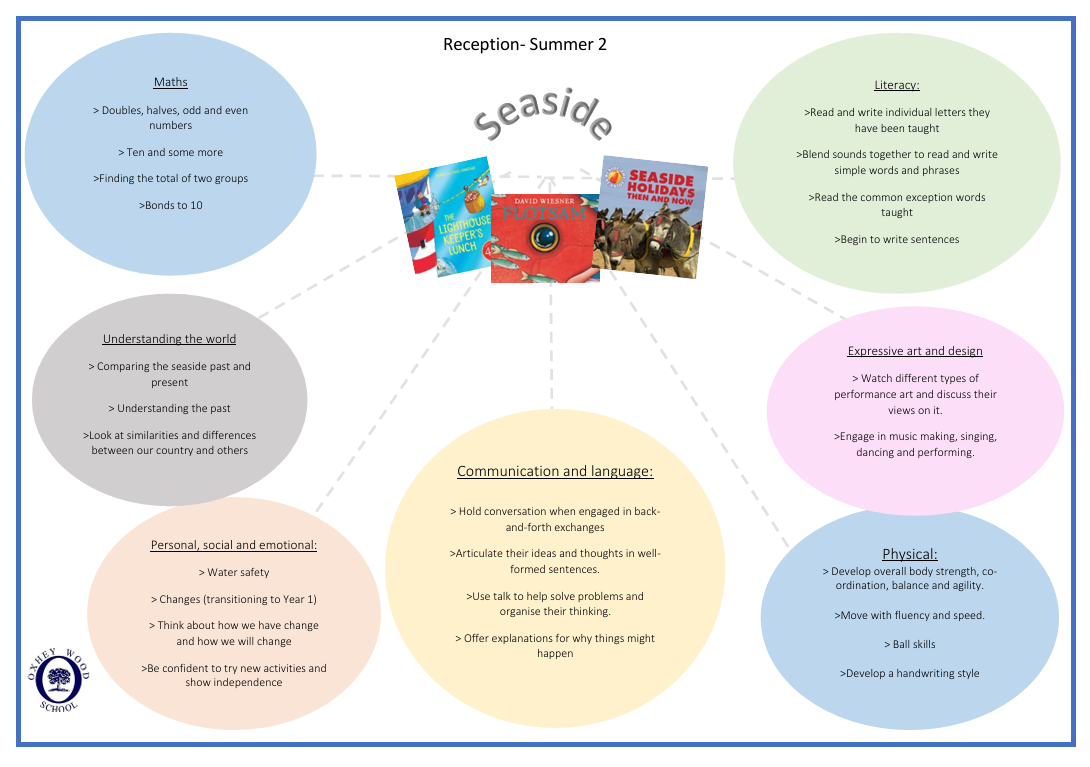
Summer 2 - Seaside
How to help at home:
One of the biggest areas of development for your child at this stage is communication. Your child will experiment with communicating in a variety of ways at school – for example, through stories, in conversations with adults and their friends, and through facial expression, movement and dance.
-Talk to them lots. Try to make the conversations as two-way as possible – children learn much more if they are in a dialogue, not just being spoken to.
-Read to your child and encourage them to read to you. Read anything and everything, not just the reading scheme books. Try to encourage your child to talk about the pictures, or to make predictions about what will happen next. Above all, it’s important for your child to enjoy reading, so try to relax, and stop when either of you begins to feel pressured or anxious.
-You can help your child build up hand strength and fine motor skills by playing with playdough. threading, paints and colouring in. This will really help when they come to learn to write.
-Support your child with writing their name, forming each letter correctly.
-Numbers are all around us, from calendars to door numbers, street signs to car registration plates. Pointing them out and talking about them with your child can show that they have a real life context.
-Have a go at forming numbers in sand with a stick, on the pavement with chalk or on sheets of paper with finger paints. Make numbers out of modelling clay, or try holding your child's finger and forming the number in the air.
-Try to involve your child in using numbers at home by singing number rhymes and songs or by encouraging them to recognise and read numbers.
Overview


